
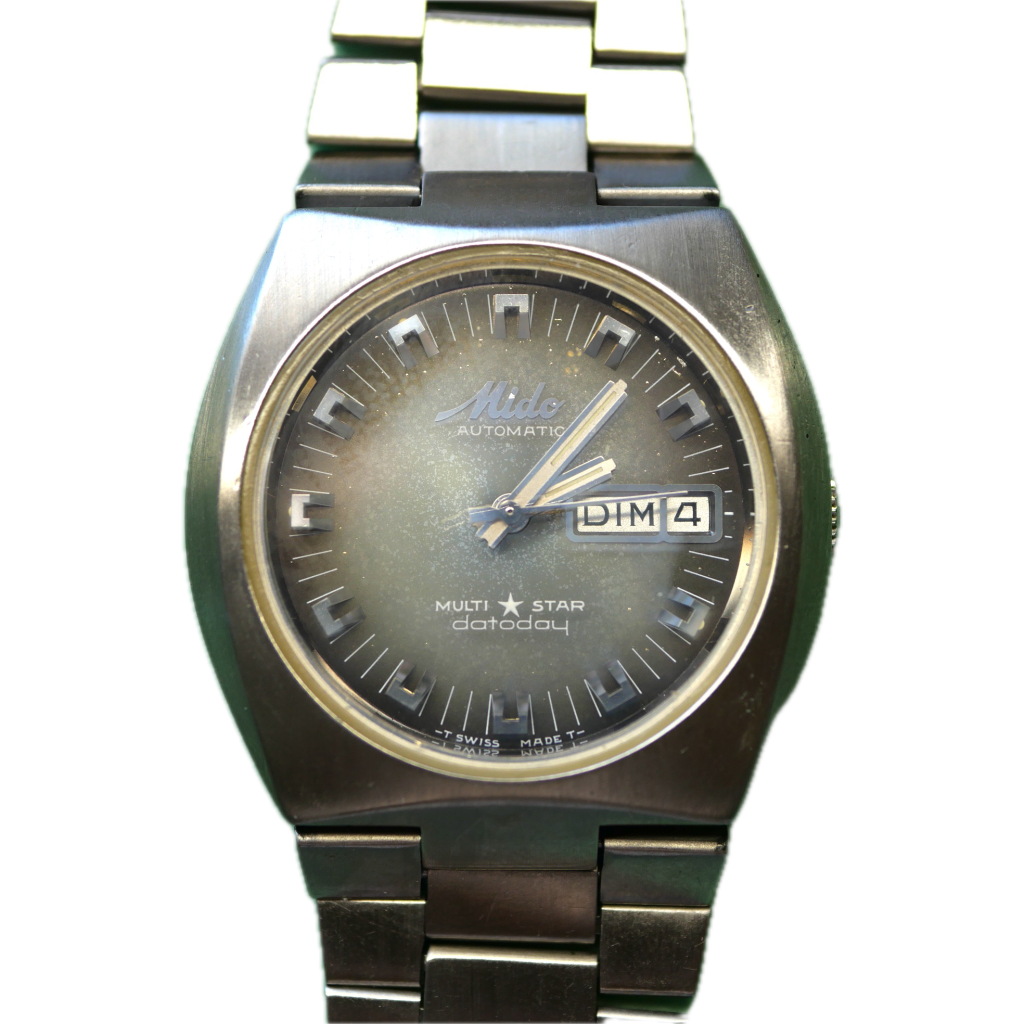
Here is a Mido Multi Star Datoday, automatic, in a steel case, which arrived directly in our workshop before any work was carried out. The anthracite gray dial with a gradient effect, the faceted baton hour markers, and the day/date window at 3 o'clock are typical of Mido production from the early 1970s. The original patina on the dial is a mark of time that only adds to the charm of the piece.
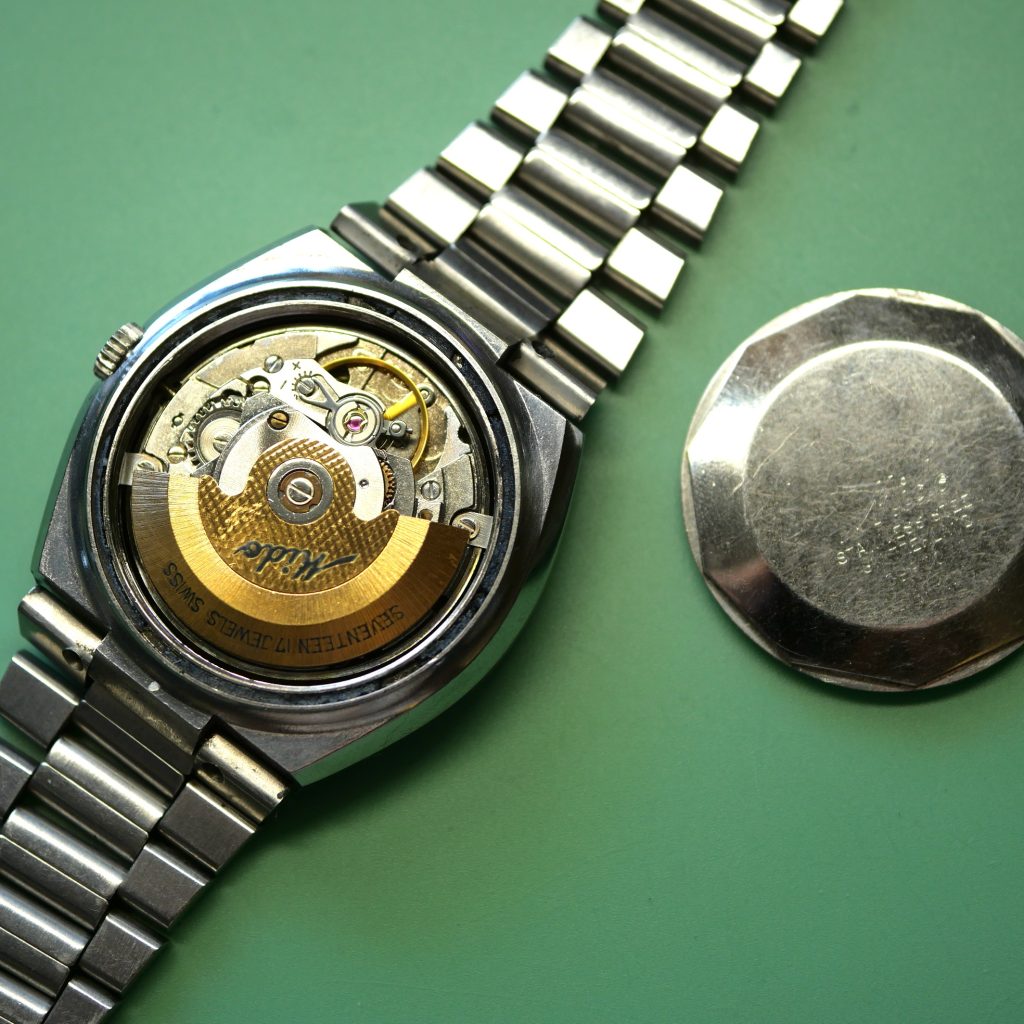
Once the case back is opened, the ETA 2790 automatic movement is revealed, with its gold-plated oscillating weight engraved with the Mido logo and its 17-jewel designation. The first check before any intervention is the amplitude. When cold, without maintenance, it tops out at 180°, a clear sign of dried-out oils and the need for cleaning, which will guide the entire subsequent overhaul.
Start of dismantling
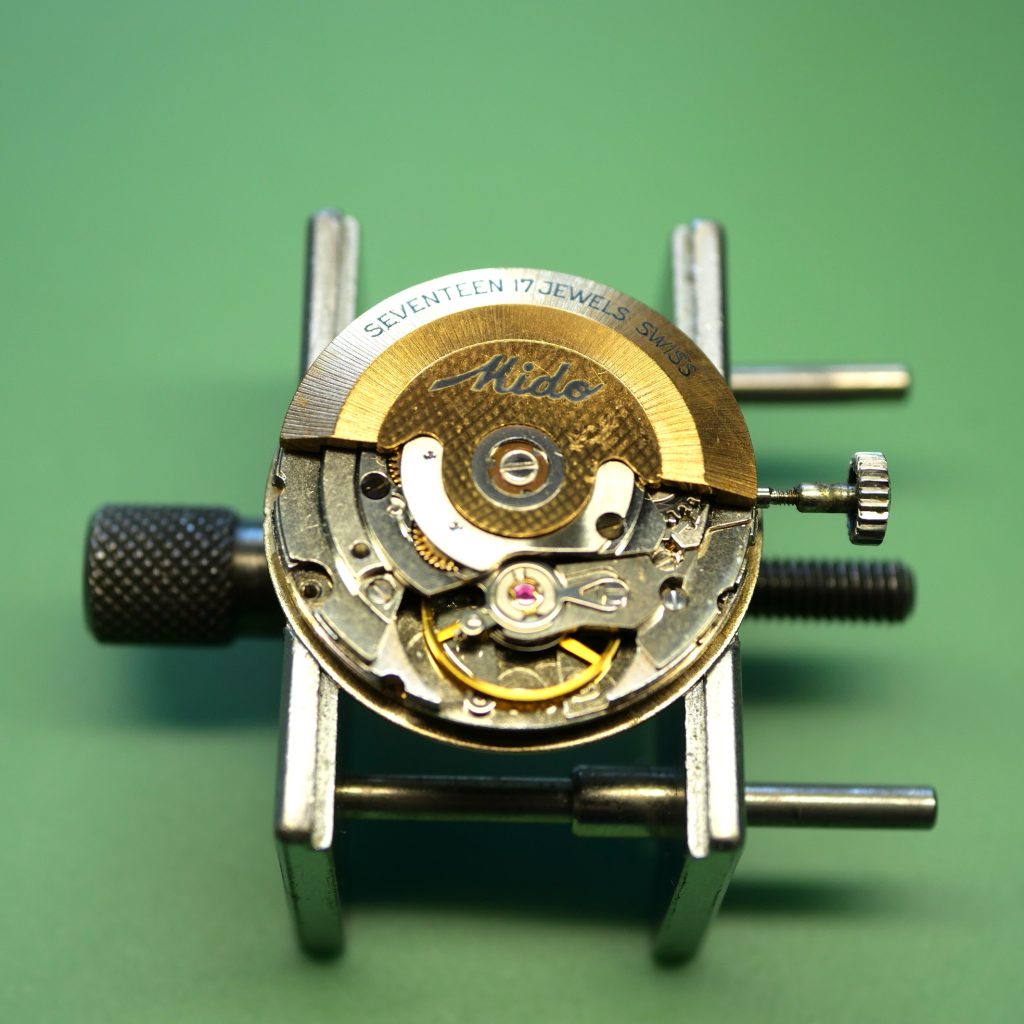
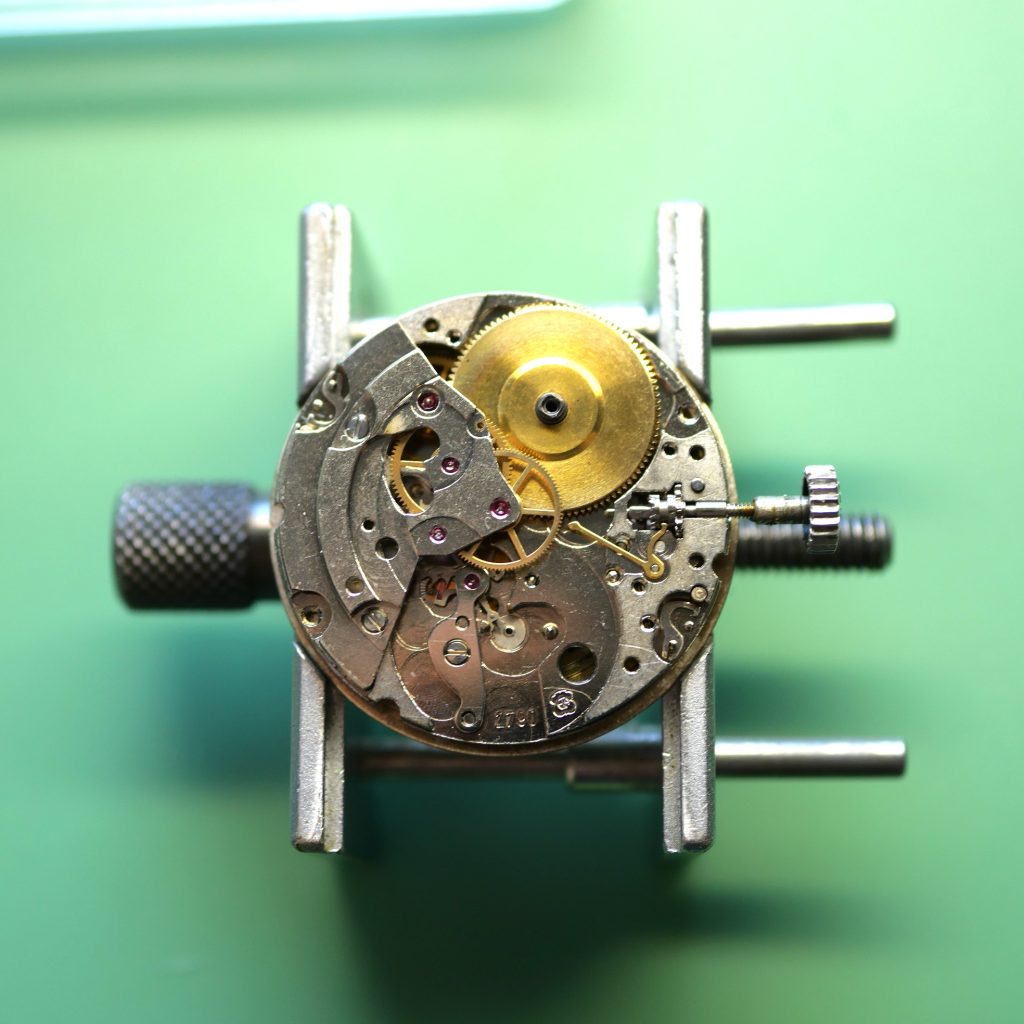
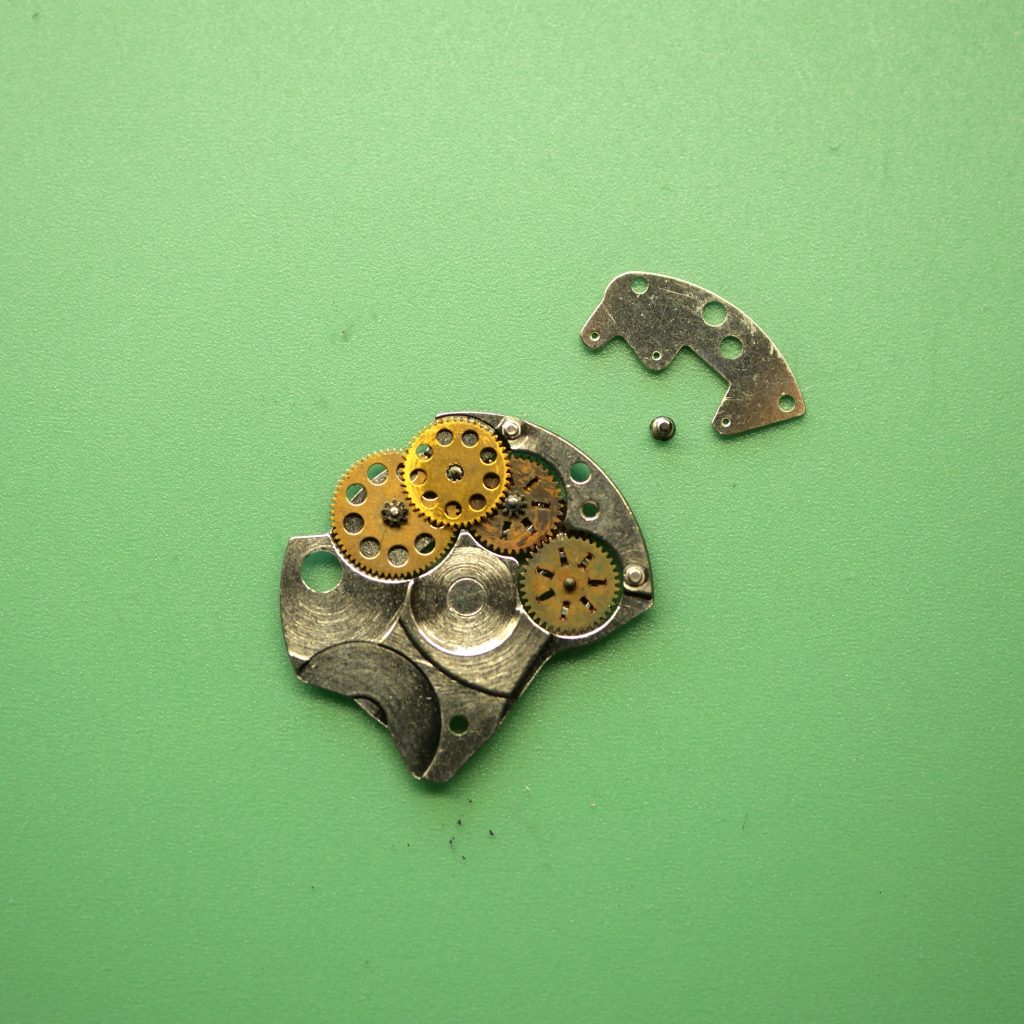
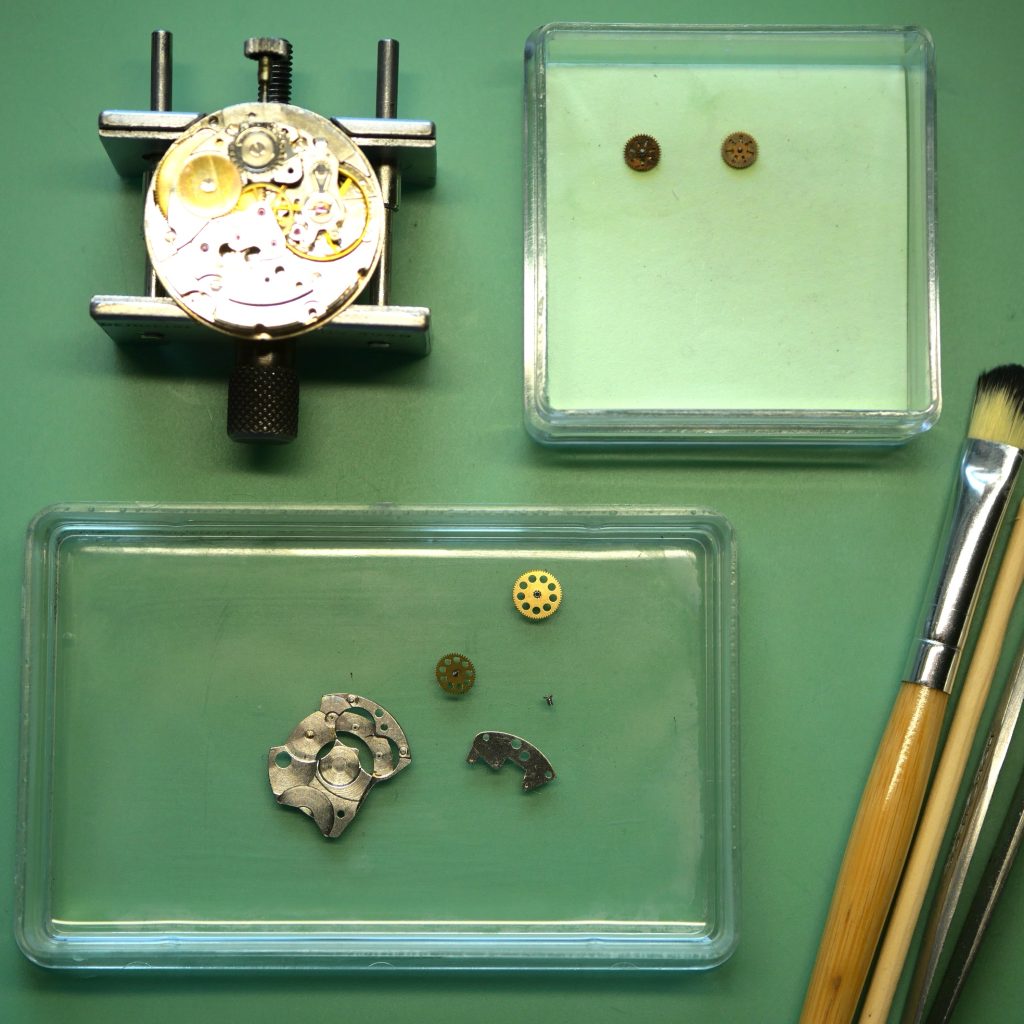
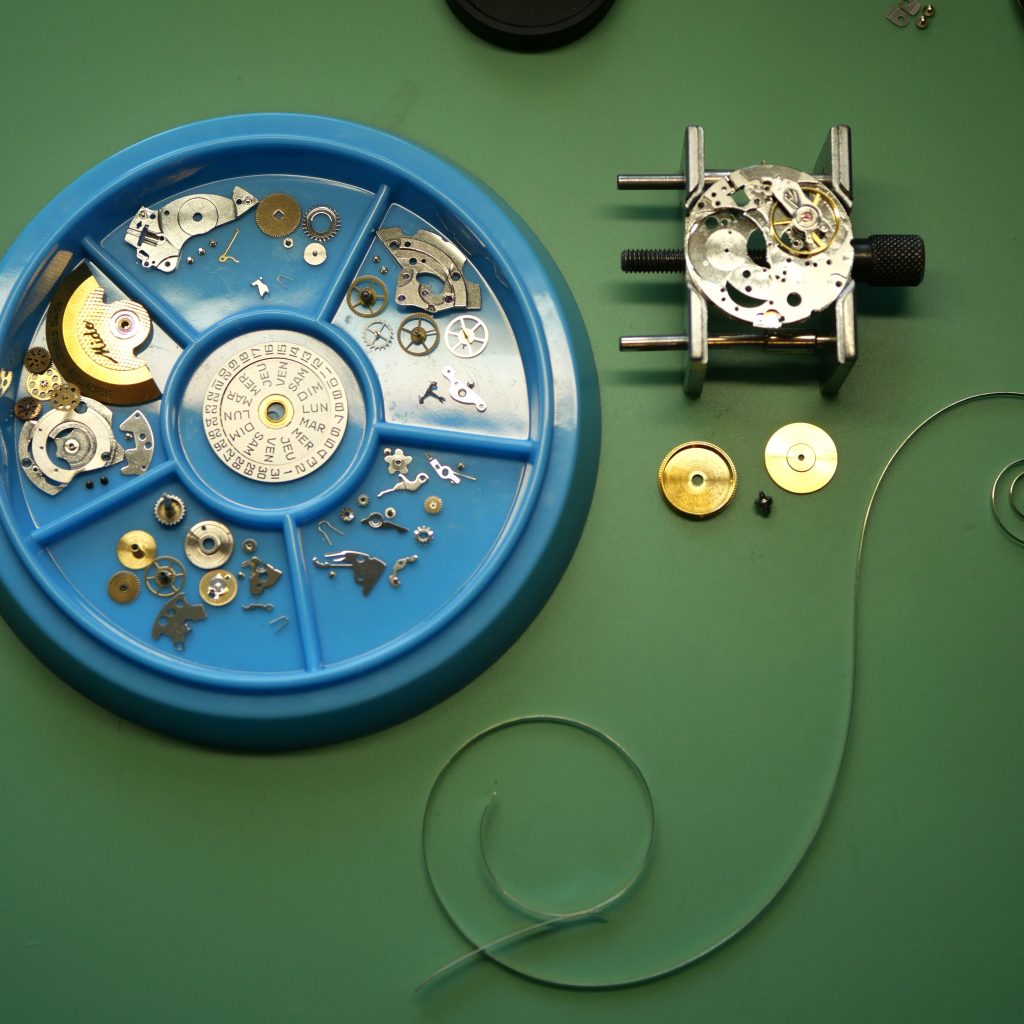
Once the movement is placed on its movement holder, disassembly begins with the gold-plated oscillating weight and its bridge, which ensures the watch's automatic winding. Beneath the bridge, the gear train is revealed, its brass gears still bearing the marks of old oxidized oil deposits. Next comes the barrel bridge, then the ratchet wheel, the crown wheel, and the click: note that the ratchet wheel's thread is reversed here, a detail to be aware of to avoid forcing it in the wrong direction. Before being placed in the rotary cleaning machine, the most delicate components are brushed manually with a fine brush to remove residue without risking damage to the pivots.
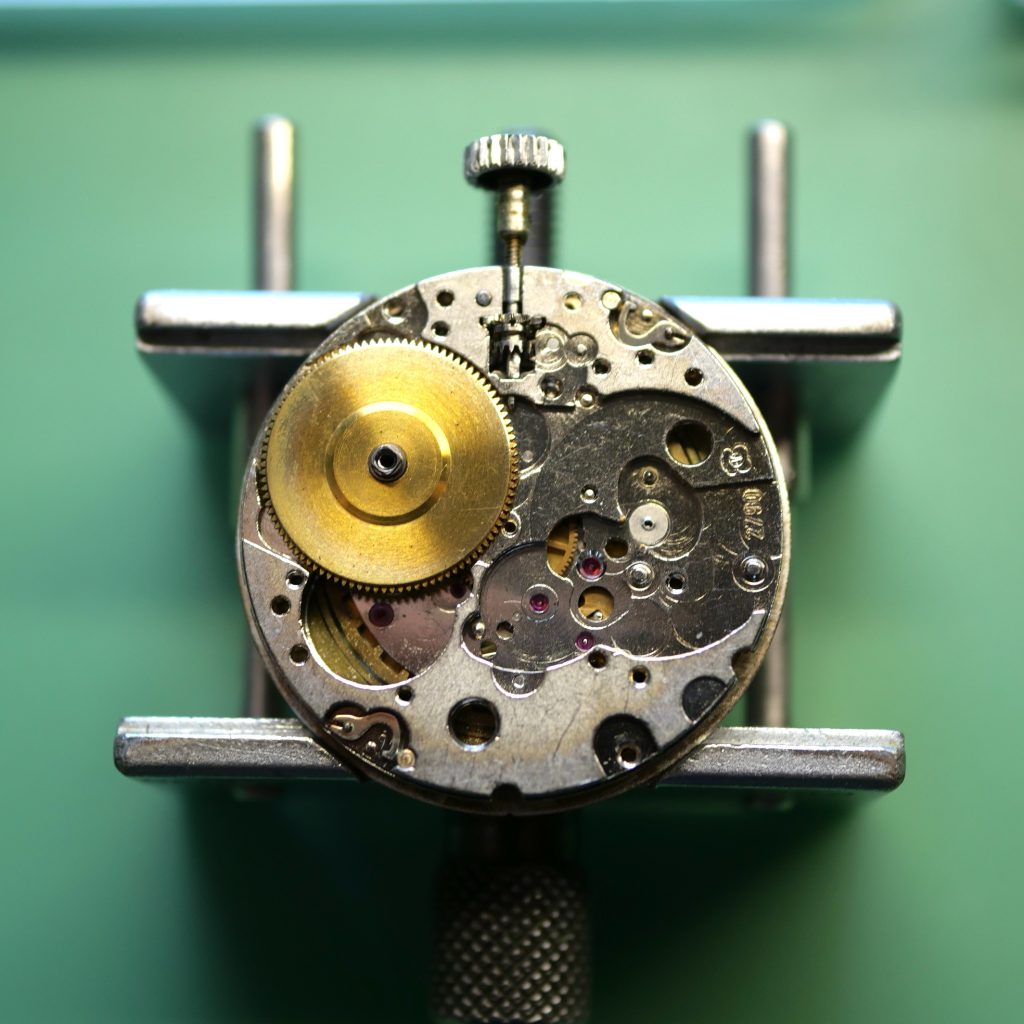
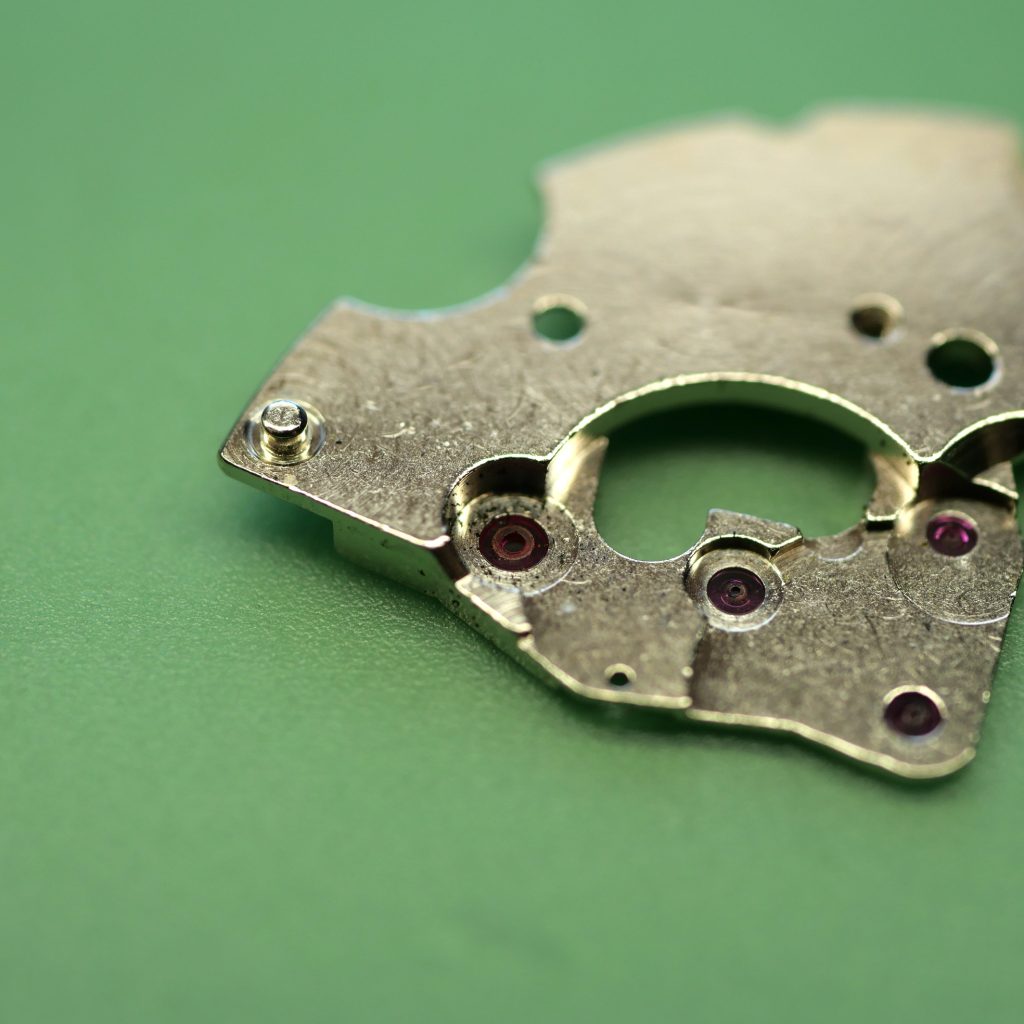
The gear train bridge is then disassembled, revealing the gear train. In close-up, the jewels and pivot points reveal the old, completely dried oil, which has become crystalline over time: it is precisely this type of residue that restricts the amplitude and which a thorough cleaning will eliminate.
Before using a professional cleaning machine, an initial bath in white spirit is carried out. This is the most effective way to remove the most stubborn residues. However, be aware that white spirit remains an impurity, leaving a thin film and slight residues; therefore, it is not recommended as a final cleaning product. Another benefit of this pre-cleaning is that it helps preserve the professional products used subsequently, preventing them from becoming clogged prematurely.
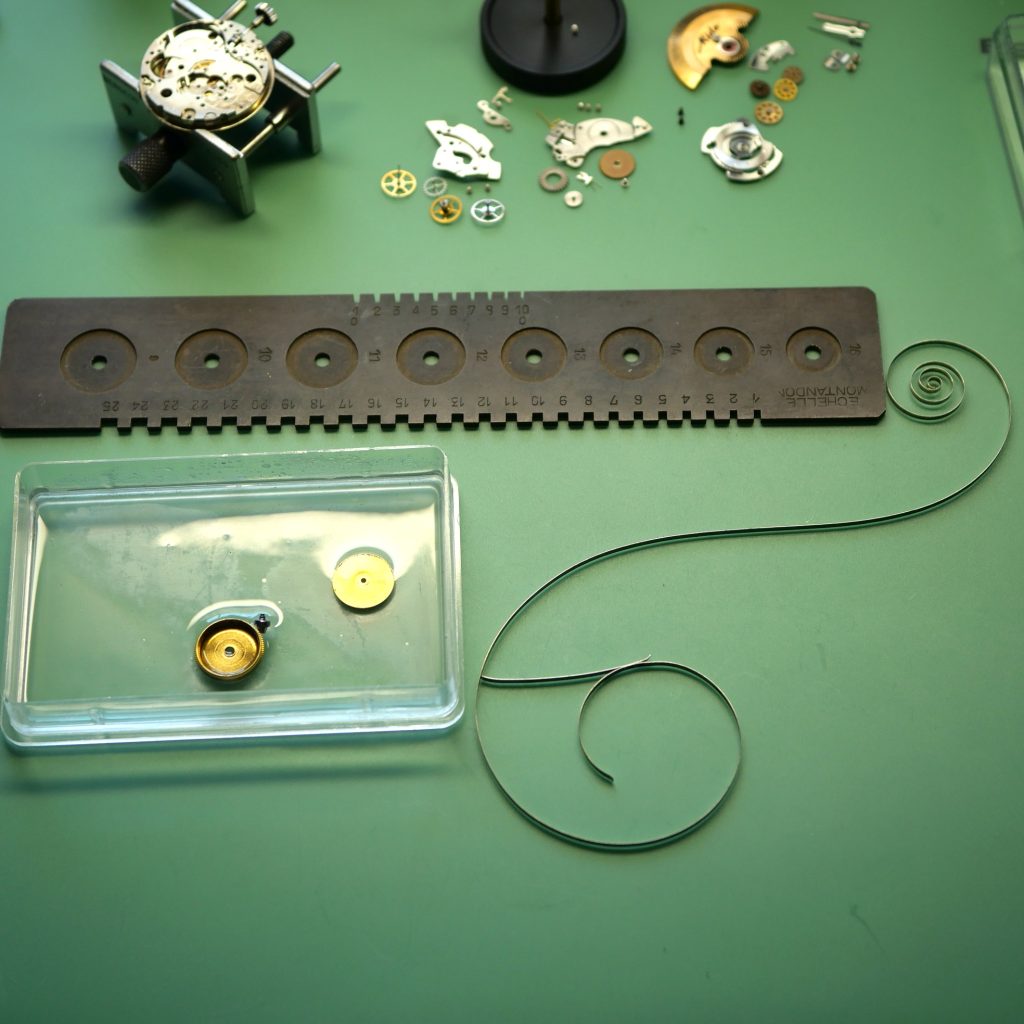
Disassembling the barrel is an essential step in any serious overhaul. This part accumulates the most oil and friction over time, so its complete disassembly is crucial for thorough cleaning. Here, the mainspring is in excellent condition: the flange is intact, the S-shape is well preserved, and the spring remains perfectly flat, without any visible deformation or wear. Cleaning will suffice; replacing the spring is not necessary.
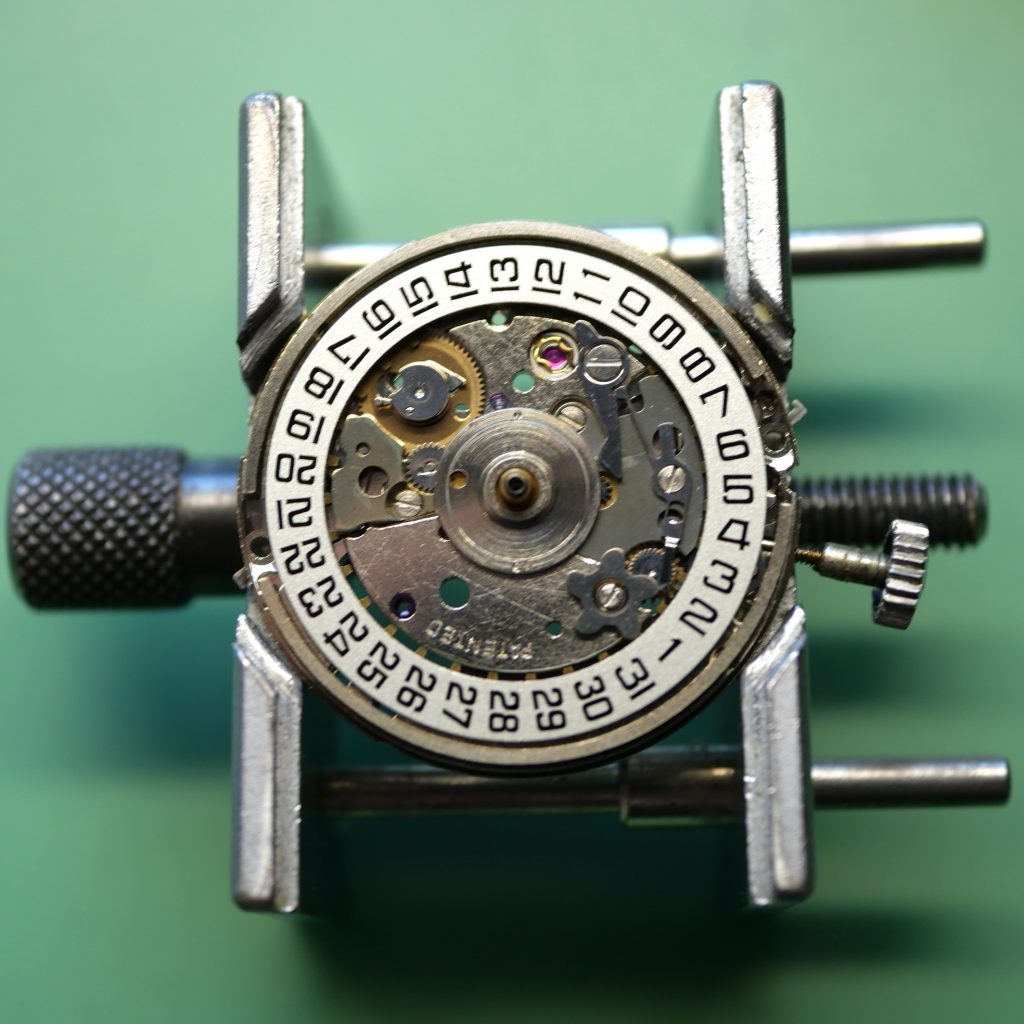
Disassembly continues on the other side of the mainplate, with the timer and date-changing mechanism. Removing the date disc reveals the instantaneous jump mechanism, then each bridge is removed one by one until the gears and springs are exposed. This step requires particular care: the tiny, tensioned return springs can easily escape if not properly held during disassembly.
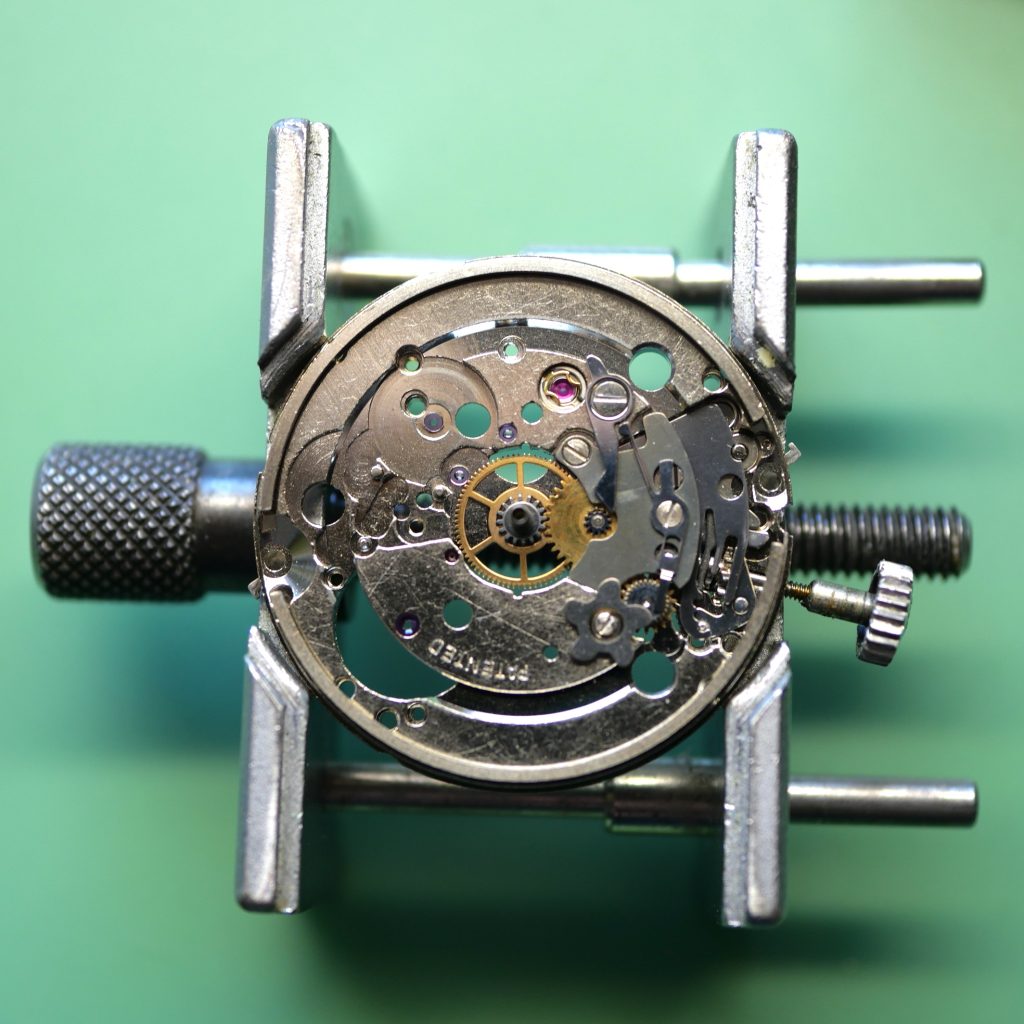
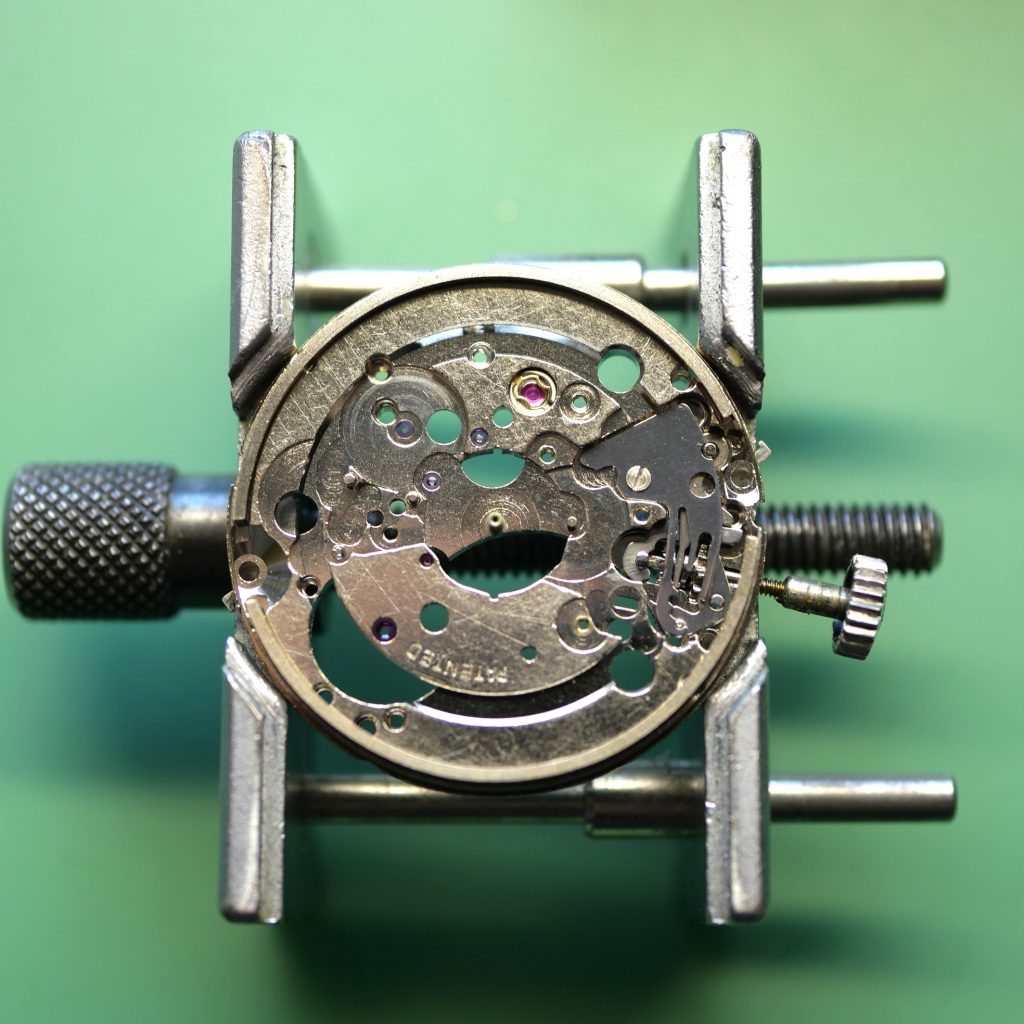
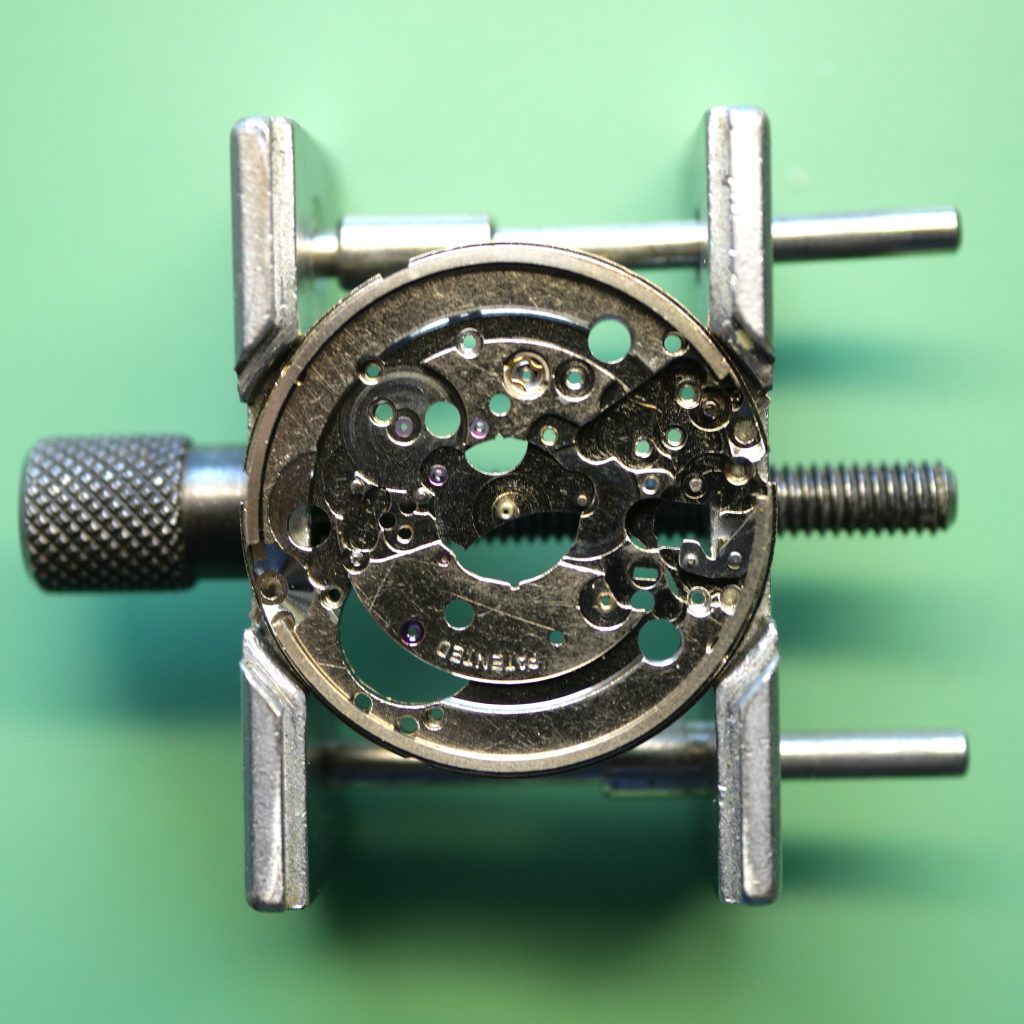
A glimpse of the movement in its raw state, the mainplate now completely free of its bridges and gears. Each part is pre-cleaned, inspected, and set aside for machine cleaning before the major reassembly.
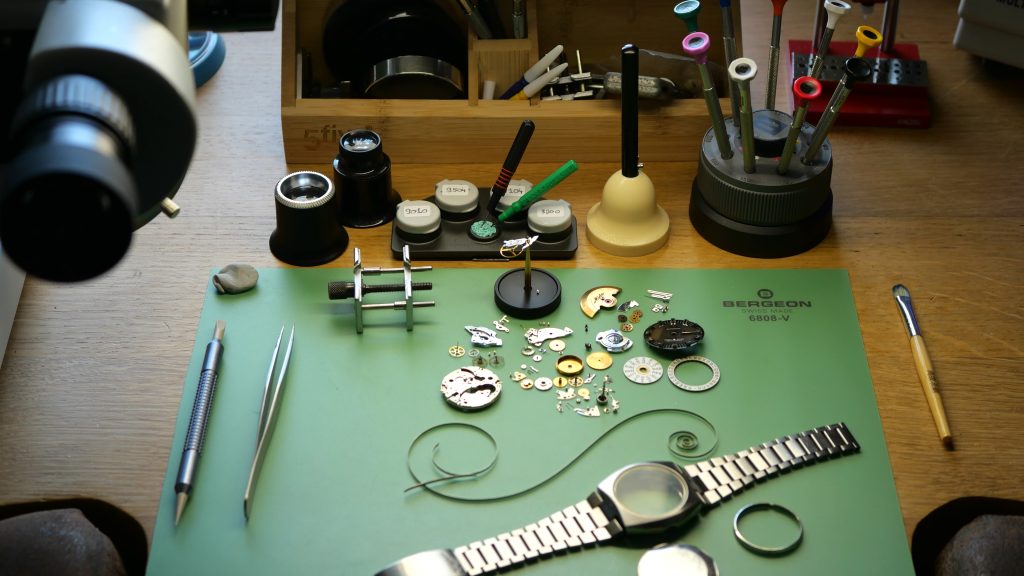
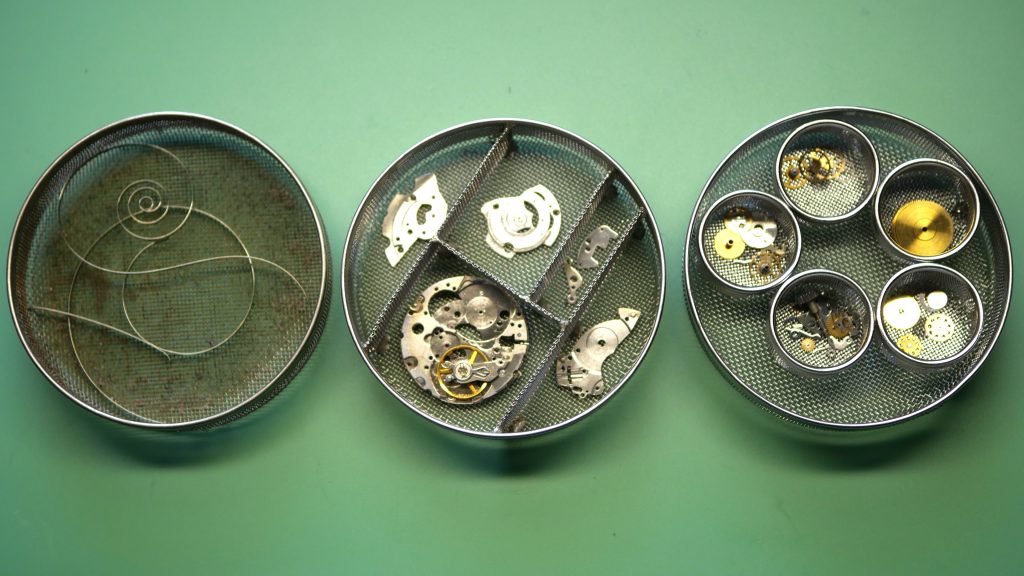
The parts are placed in their cleaning baskets, ready for the rotary machine. However, the reversing wheels, the anchor, and the counter-pivots of the balance wheel are set aside, as they are too fragile to withstand the agitation: they will be cleaned separately by hand.
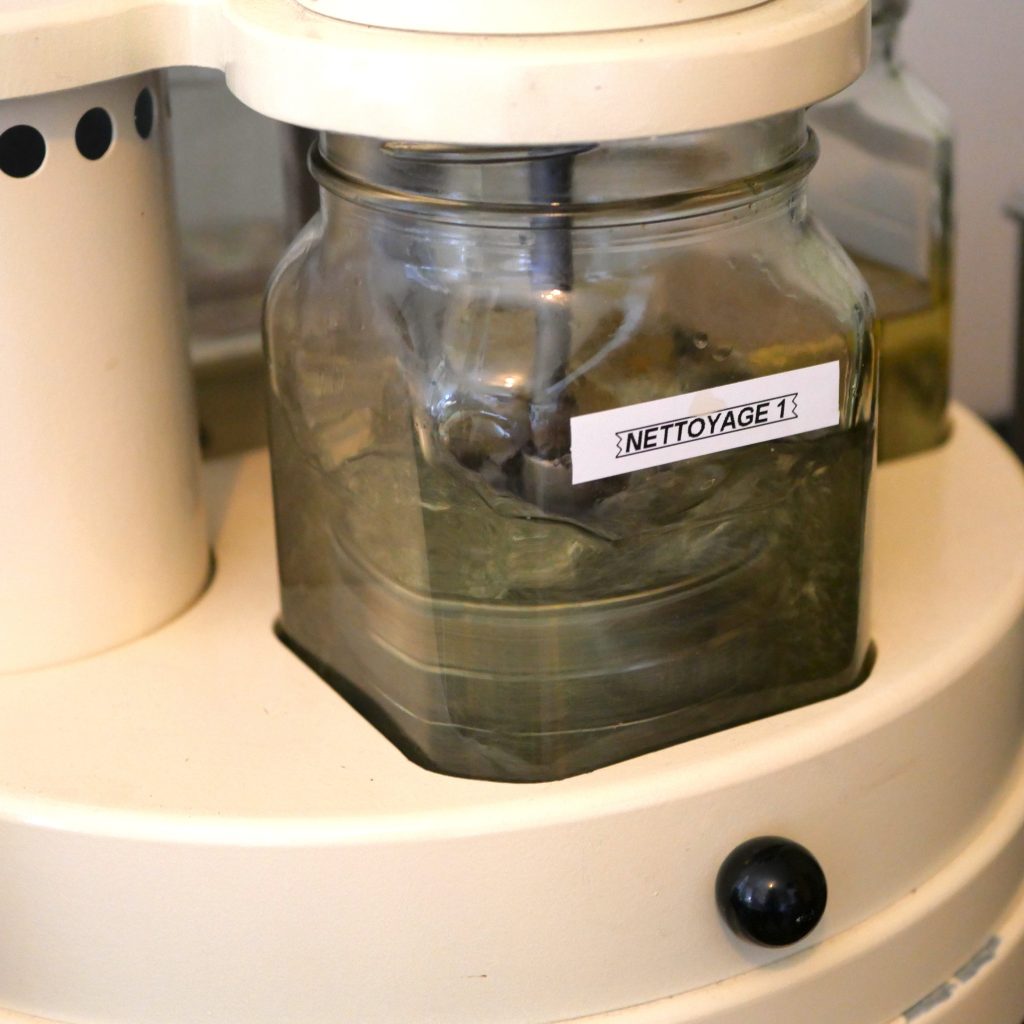
The baskets go through the Elma rotary machine: 10 minutes in cleaning tank 1, then 5 minutes of rinsing, and finally 3 minutes of final rinsing. The cycle ends with 20 minutes of drying. During this time, the parts rejected by the machine are cleaned and sorted manually, ready to rejoin the others for reassembly.
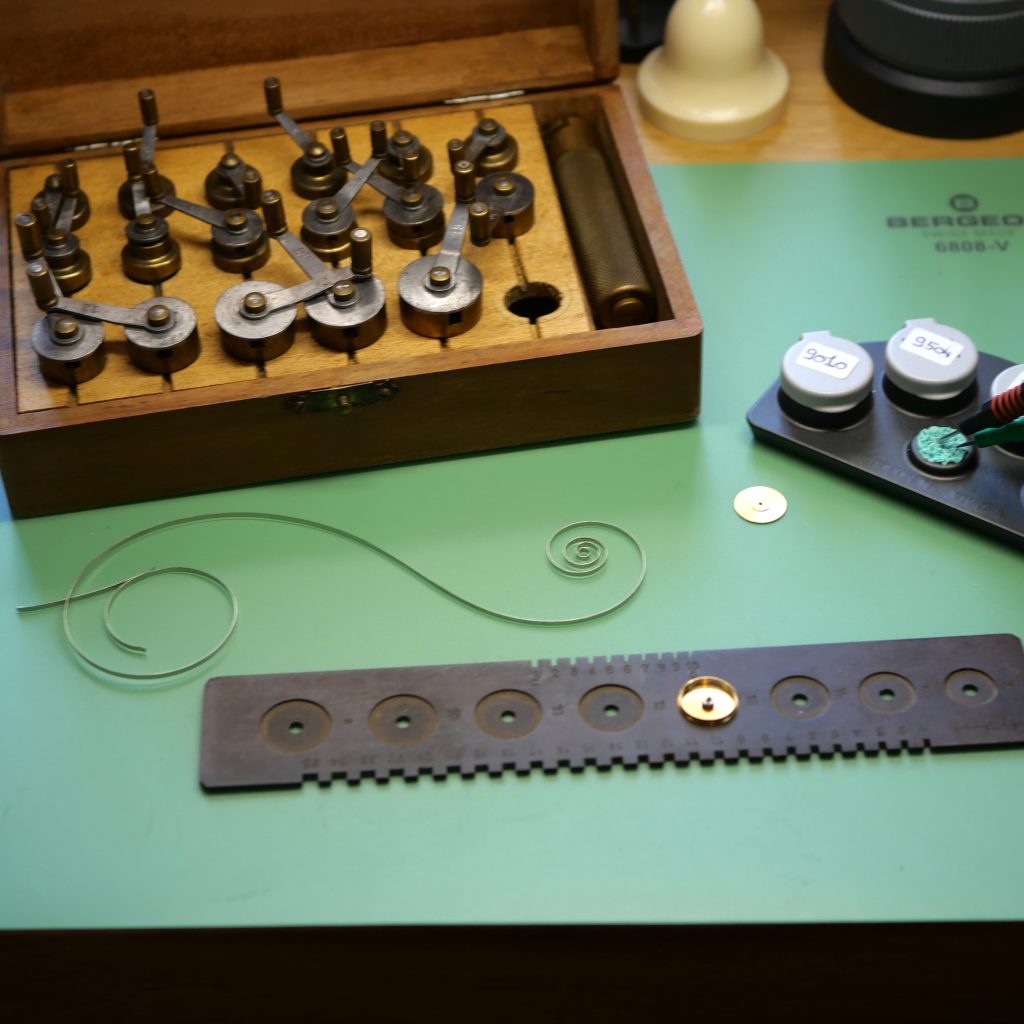
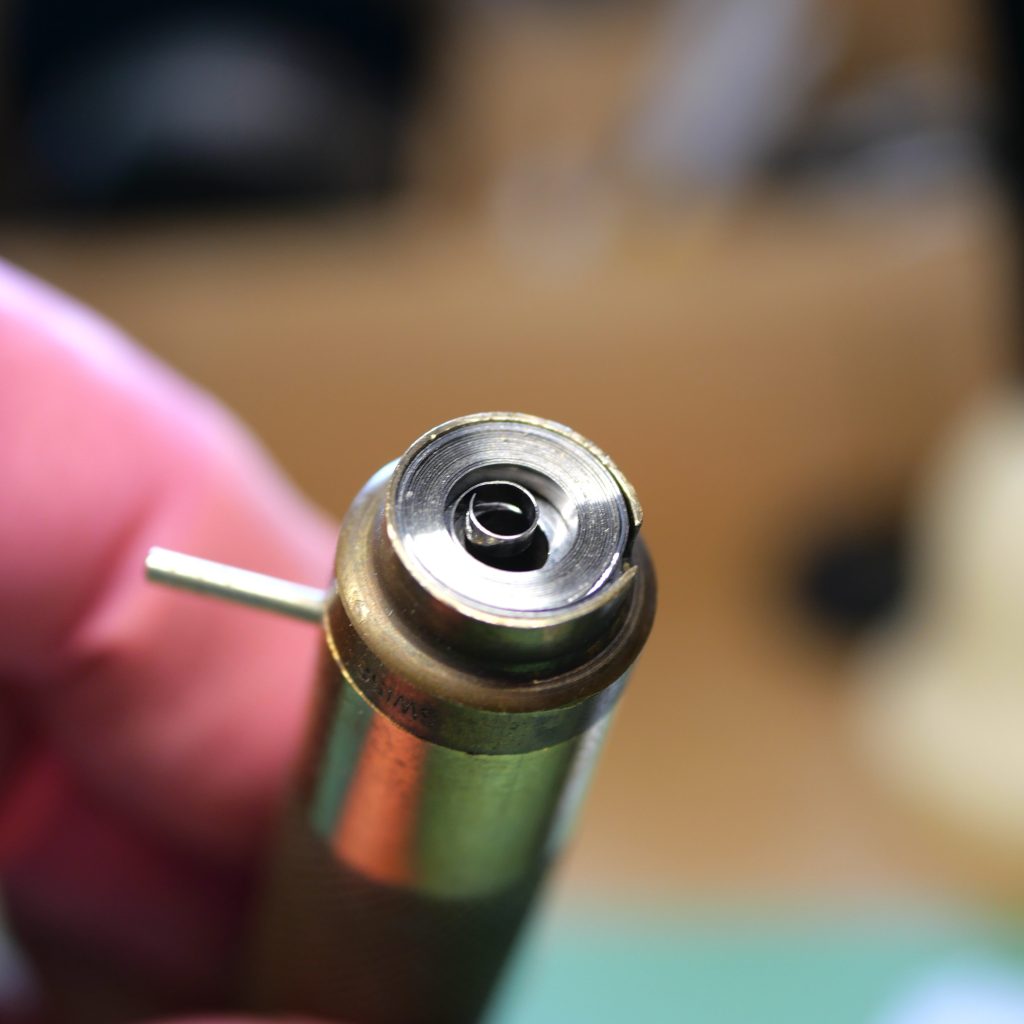
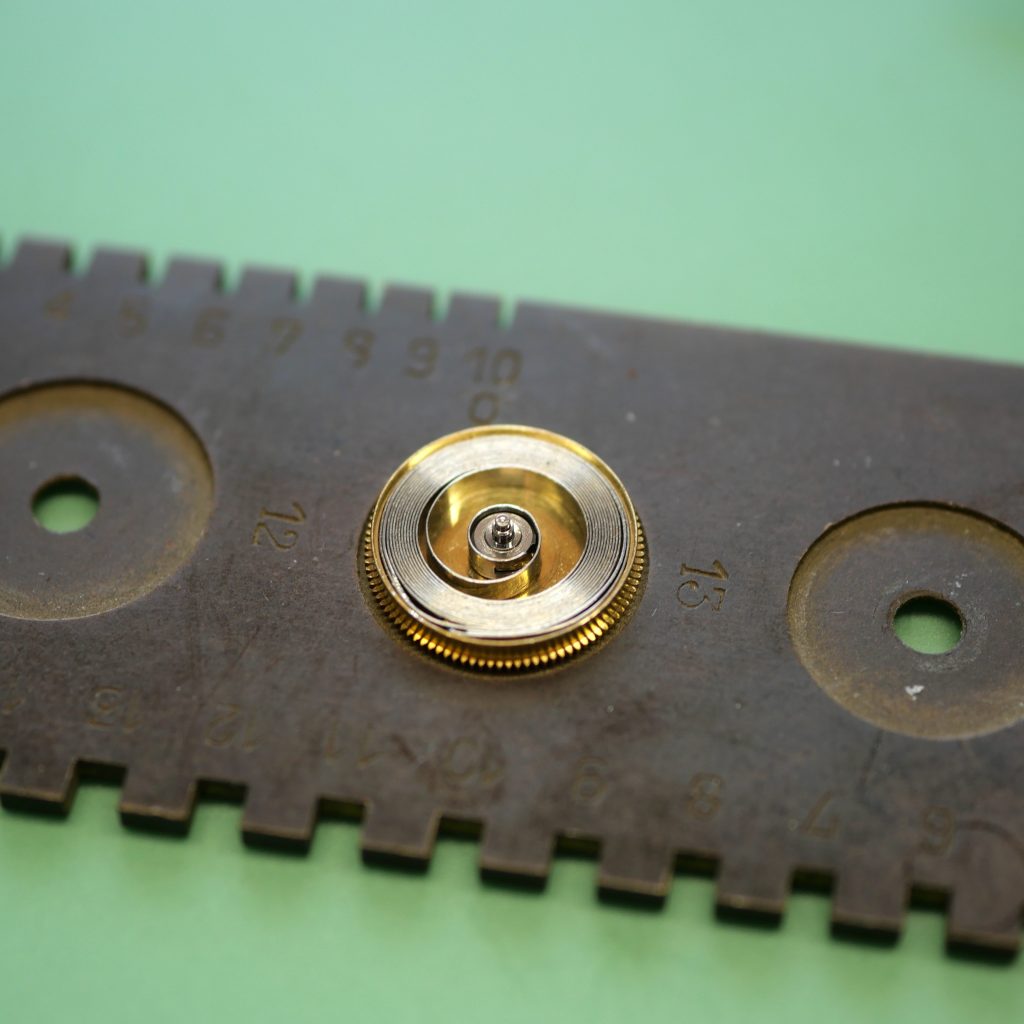
The mainspring is wound into its barrel using a set of winding clips, a specialized tool that allows the spring to be wound and neatly reinserted into the drum without risk of deformation. It is lubricated along its entire length before being wound. The barrel is then closed and reinstalled on the mainplate, ready to power the gear train once again.
Reassembly can begin. Each component is returned to its place on the mainplate. The pivot points are oiled according to the caliber's specifications. The balance wheel's counter-pivots receive particular attention: thorough cleaning is essential, followed by a precise application of a drop of oil in the center. The functions are checked as the reassembly progresses.
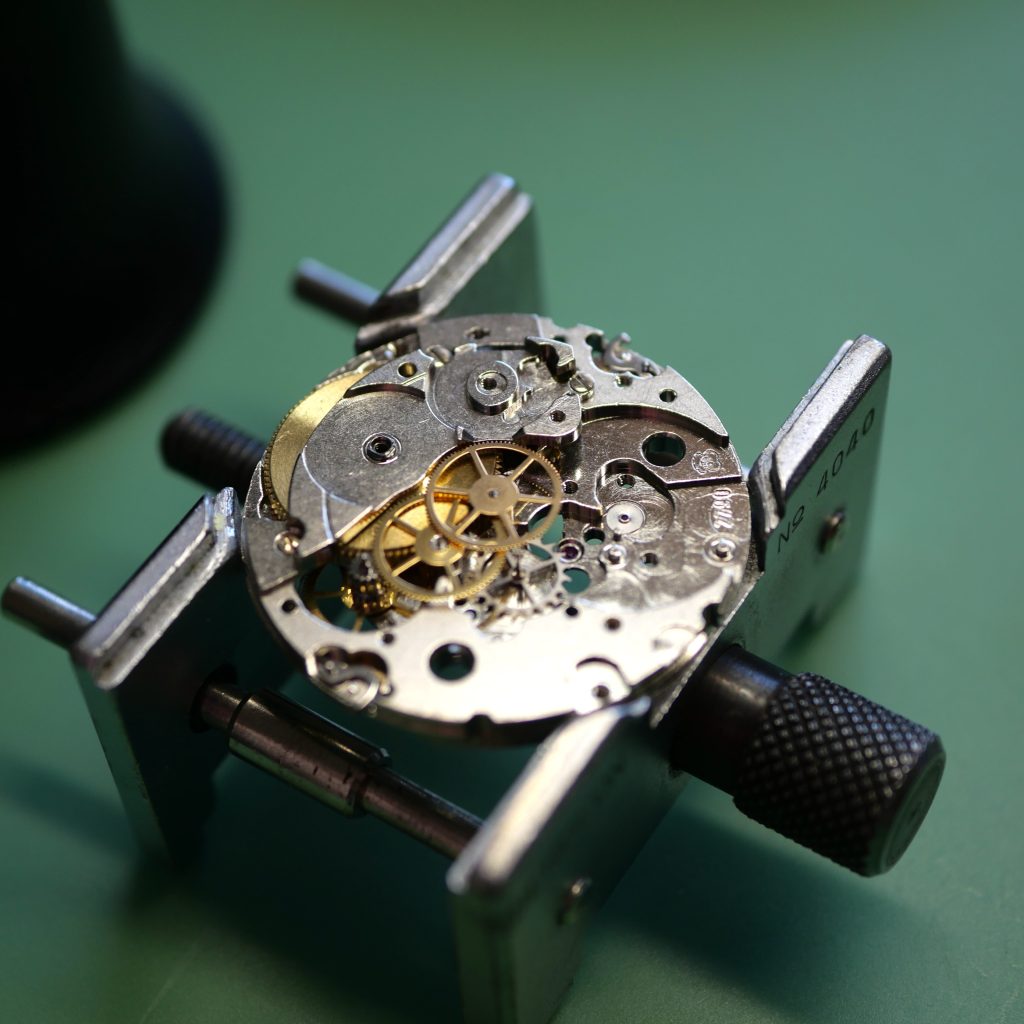
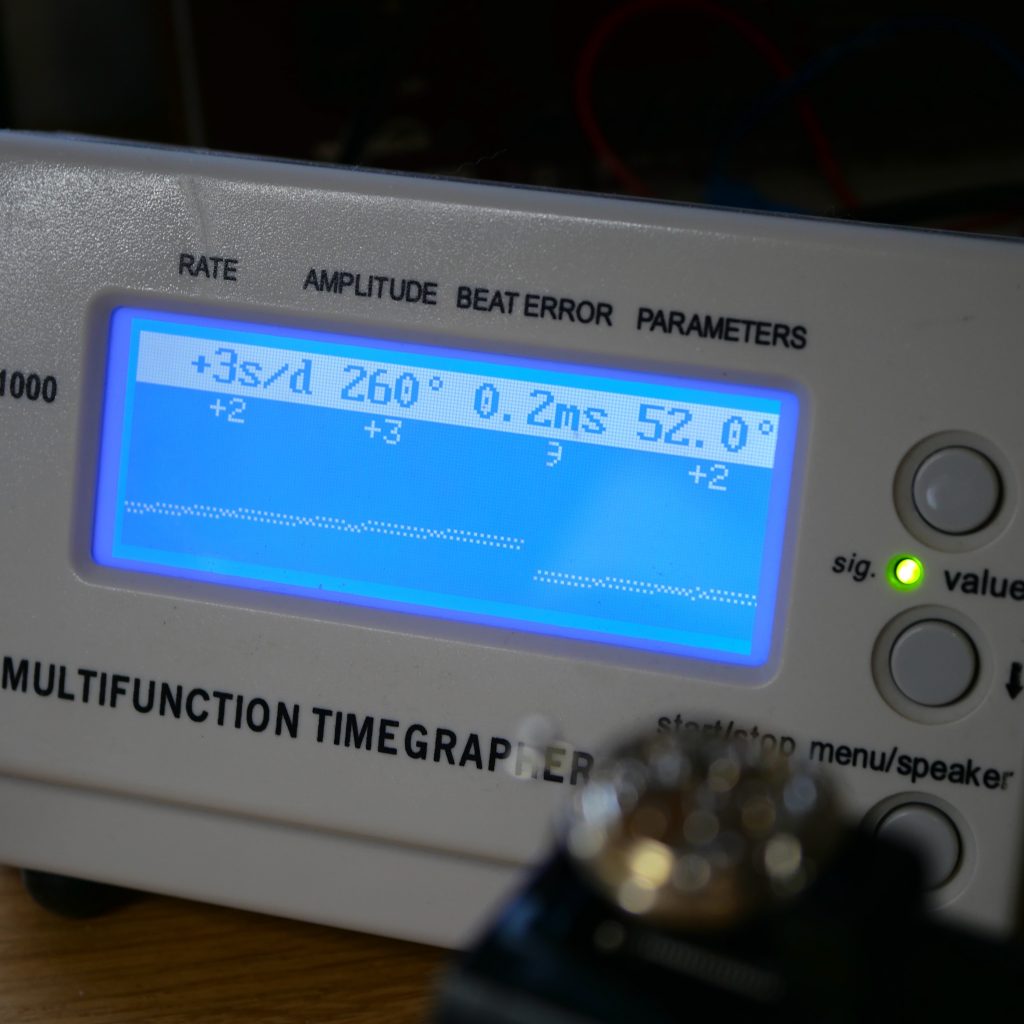
The movement was then placed on the timegrapher for checking and adjusting the balance wheel. The result was very satisfactory: the amplitude increased from 180° initially to 260° after servicing, without replacing the mainspring, proving that cleaning alone was sufficient to restore the caliber's full strength. The movement's accuracy is excellent for its age.
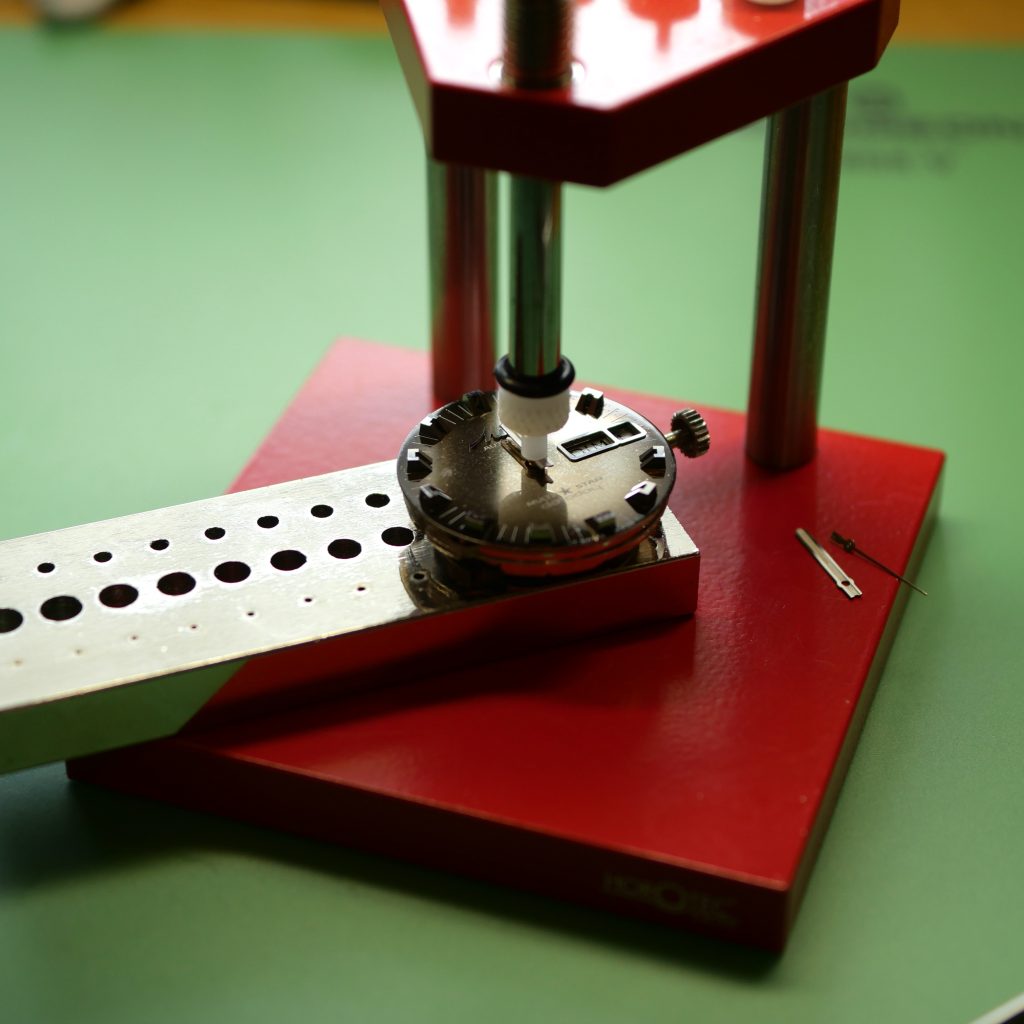
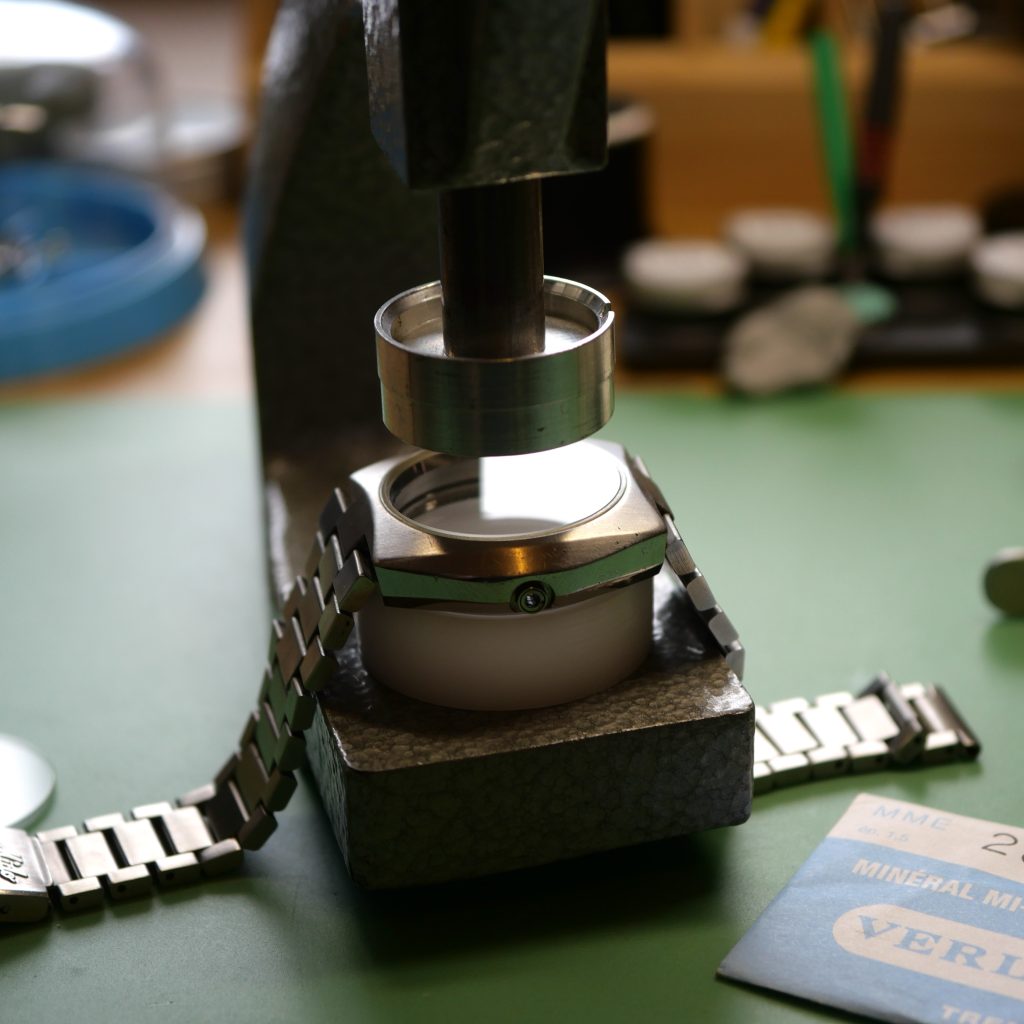
The final stage is approaching. The hands are reassembled using a press, ensuring the date changes correctly at midnight before closing. The original crystal, a mineral glass marked with a deep scratch in its center, is replaced: unlike Plexiglas, which can be polished, mineral glass cannot be restored. A new crystal is then pressed into place.
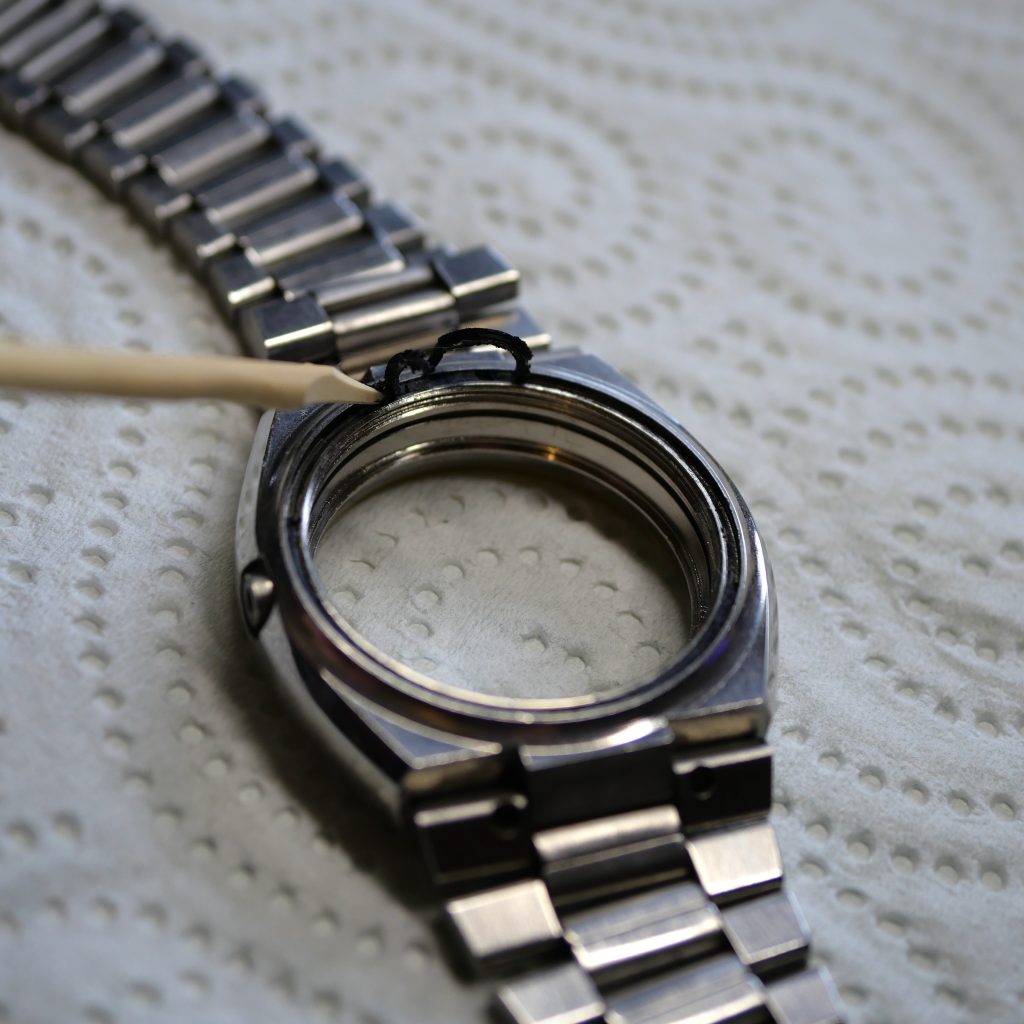
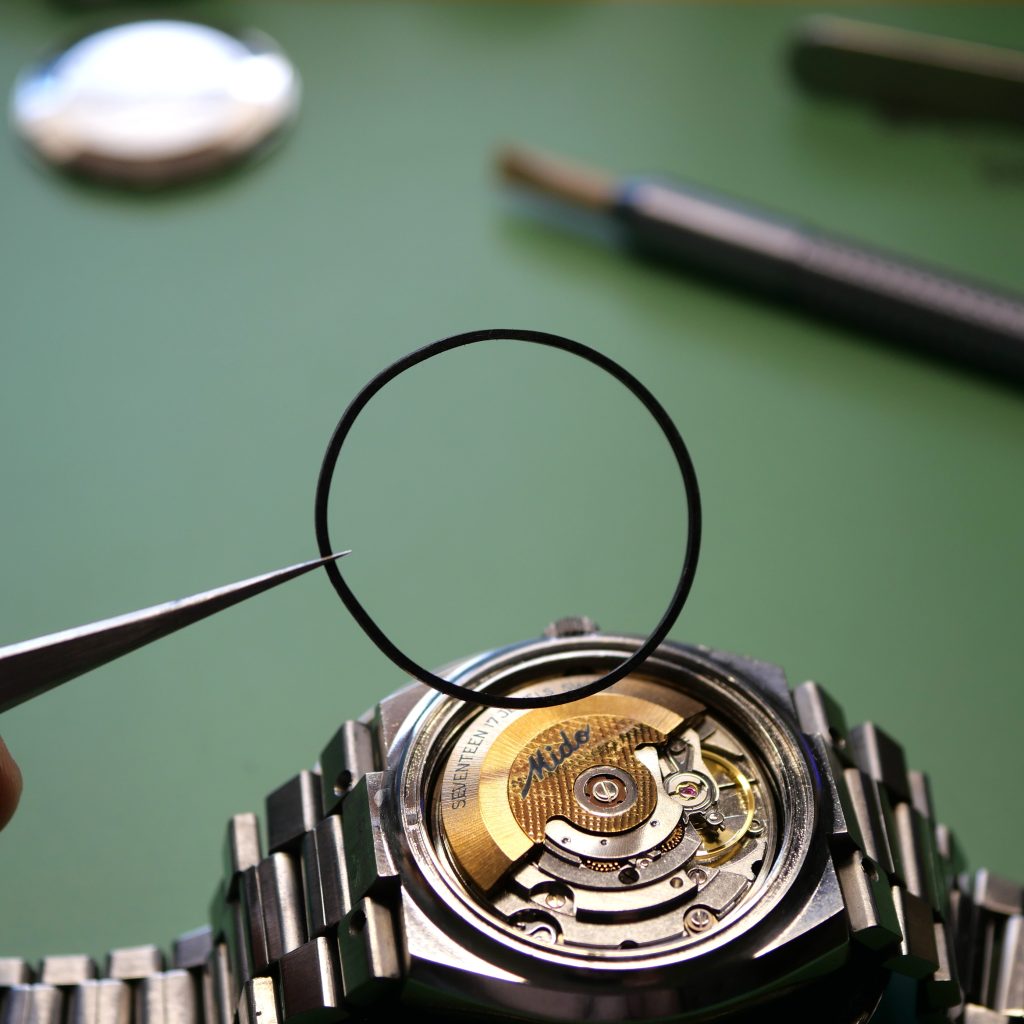
The bottom seal, which had melted over time, is replaced.
The case and bracelet are cleaned, the case back receives a very light polish. The movement is reassembled, the case back is screwed down, and the Mido Multi Star Datoday is restored to its former glory.
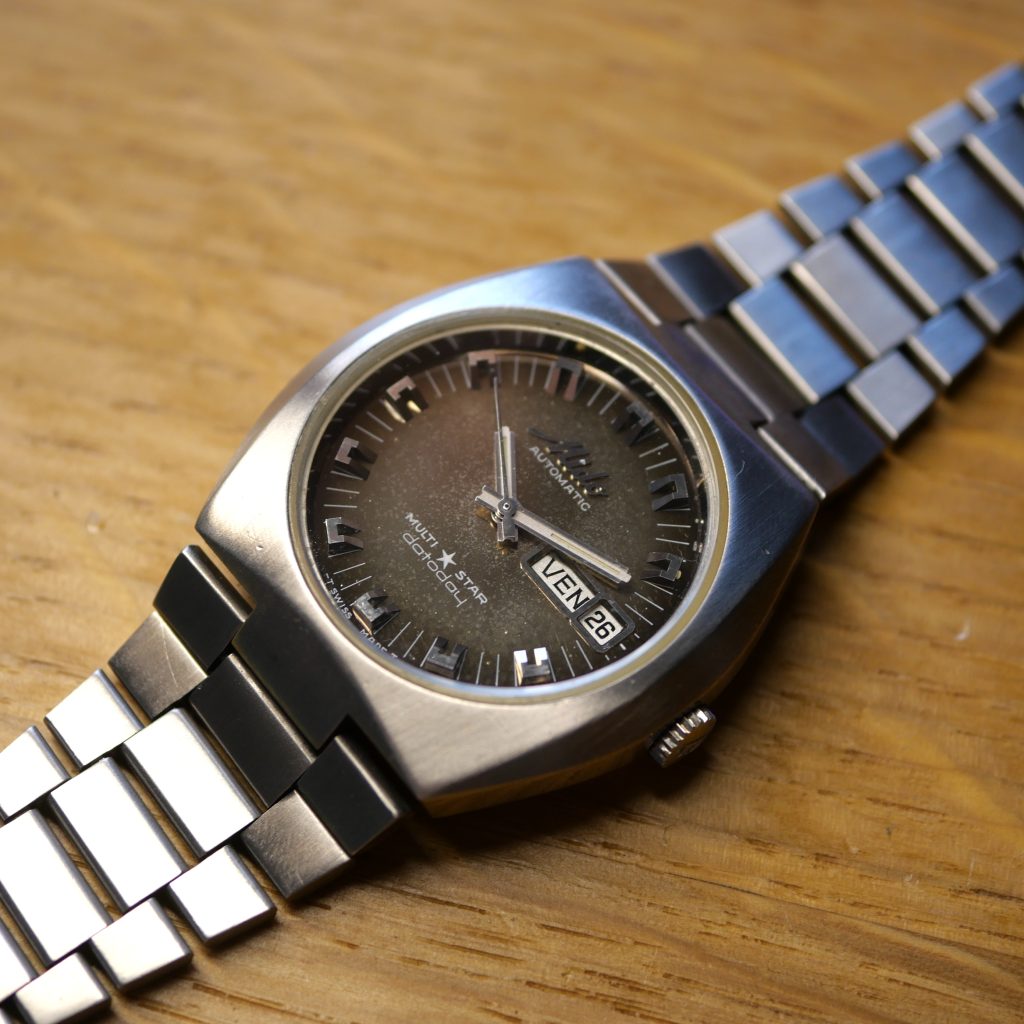
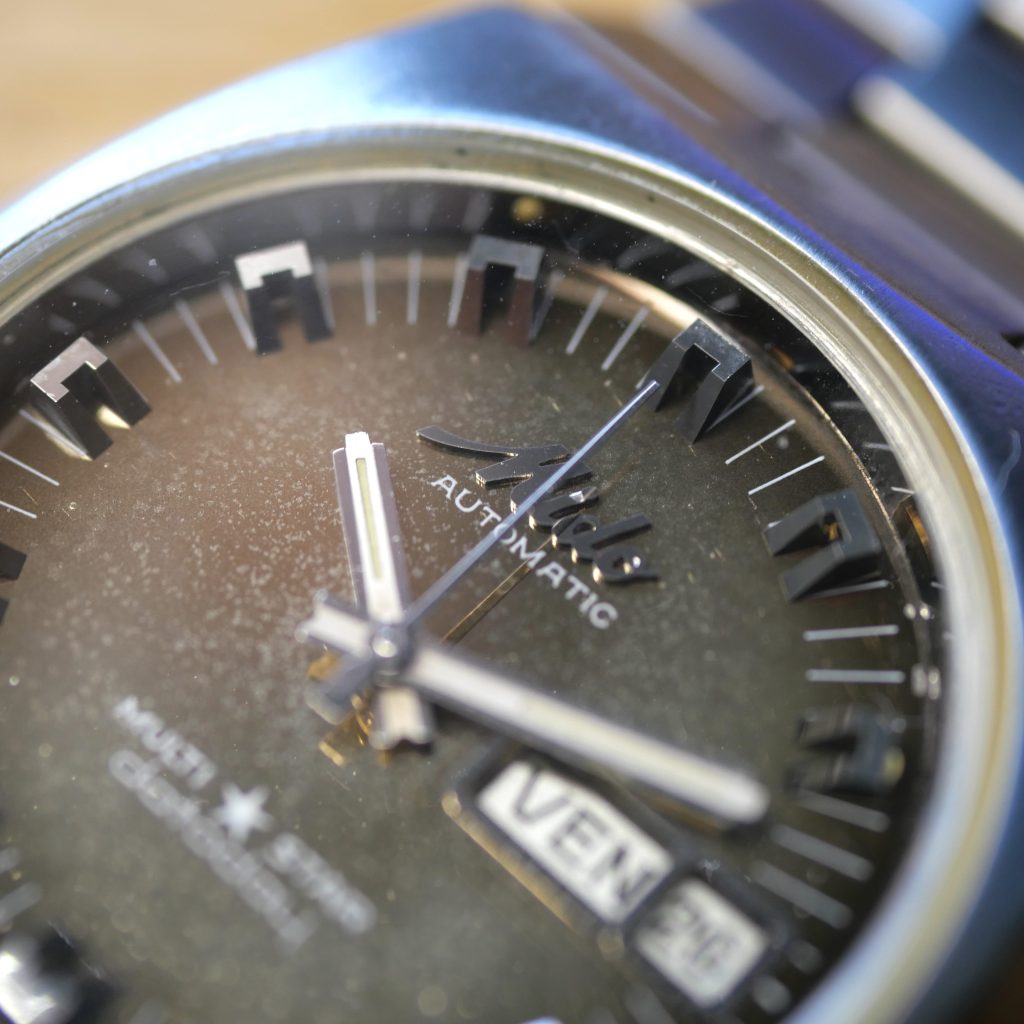
This overhaul clearly illustrates what a serious restoration can bring to a vintage caliber: without replacing major parts, solely through complete cleaning and careful oiling, the ETA 2790 regains an amplitude and precision worthy of a movement in perfect condition.
It's always a pleasure to work on this type of watch. The Mido Multi Star Datoday is a quality timepiece, equipped with a reliable Swiss movement and particularly enjoyable to service. Not all aspects of a complete overhaul have been covered here, but the essentials are included.
Mido is set to continue for many years to come.